
Did you know that giving your child space to talk through their mathematical thinking can help them become more flexible and confident mathematicians?
Being good at maths isn’t about being the fastest person to get an answer.
Research into mathematical fluency suggests that children develop stronger number sense when they learn to work with numbers flexibly. This means pulling numbers apart, trying different strategies, finding relationships, and understanding why something works rather than simply memorising an answer.
Number talks are a simple way to encourage exactly this kind of thinking.
So, what is a number talk?
It’s exactly what it sounds like: a short conversation about numbers. The most important rule to number talks is to discover how your child is thinking, not just if they know the answer.
A number talk can be as simple as rephrasing a question.
Instead of ‘What does 8 + 9 equal?’ try, ‘How many different ways could you solve 8 + 9?’
Give your child some thinking time, then ask:
- “How did you work it out?”
“Could you solve it in a different way?” - “Oh, I like your way of thinking. When I solved it, I added 8 + 10 to make it easier then I took 1 away. Why do you think I did that?”
- “Which strategy do you prefer and why?”
In looking for thinking rather than speed, you show your child that numbers are flexible, strategies can change and be used elsewhere, and there isn’t necessarily one ‘best’ way to solve a problem. This helps them see maths as something they can explore and make sense of, rather than a set of rules they simply have to remember.
Using picture prompts is another engaging way to begin a number talk.
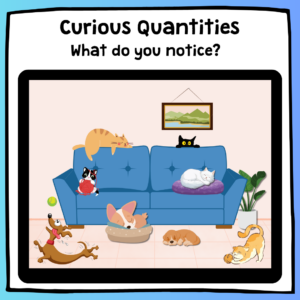
Take a look at the image above.
There is so much mathematics hidden within it! Picture prompts encourage children to look closely, notice patterns, make connections, and share the mathematical ideas they discover. They also help children see how mathematics exists in the world around them and make meaningful connections between what they learn in the classroom and real-life situations.
Keep the question open: ‘How could you connect the picture to any maths ideas?’
Children might begin to notice and share ideas such as:
- 4 cats on the couch + 4 animals on the ground = 8 animals altogether.
- 3 out of the 8 animals are dogs, which is 3/8.
- There are 8 animals altogether and 4 are sleeping, so 4 animals are awake.
This is what we call an open-ended task. There is no one correct answer. Instead, children are encouraged to explore the picture, make mathematical connections, and explain their thinking. Different children may notice different mathematical ideas, making the discussion rich and meaningful.
We’re not looking for speed. We’re looking for thinking.
Children who take their time, think deeply and use flexible strategies are doing something incredibly valuable.
That’s why we love building number talks into our maths lessons. We look for opportunities to spark curiosity, encourage mathematical discussion and give children space to share their thinking. They can explain their reasoning, listen to different ideas and discover that there isn’t always one ‘right’ way to think about a problem. It’s about helping children see maths as something they can explore, make sense of and talk about.
Next time your child gives you an answer, resist the temptation to simply say “Well done!”
Instead, try: “Tell me how you know.”
You might be surprised by the mathematics that follows.