Step 3: Start lesson 1 and have a look around

Students will build on their understanding of doubling by using it to break apart larger amounts, allowing them to effectively double and halve numbers with confidence. This will help deepen their number-sense and enhance their problem-solving skills. Students will use their knowledge to solve animal lineup cards by solving challenges.

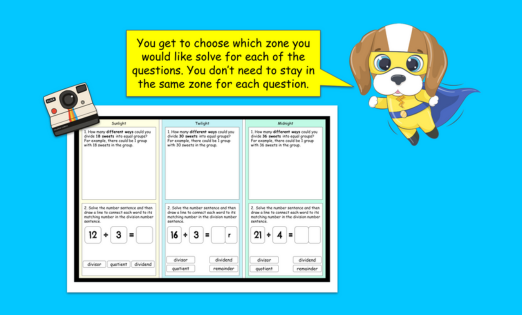
Students will be introduced to division vocabulary and break down number sentences into dividend, divisor, quotient and remainder. They will use this vocabulary when solving division would-you-rather scenarios using skip counting.

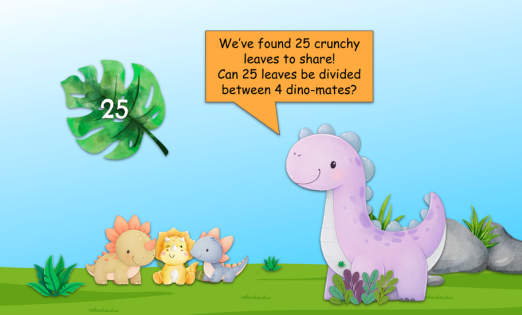
Students will continue to apply their knowledge of dividing and division vocabulary, whilst exploring remainders in more depth. They will play a game called Dino Division to practice solving division with remainders.

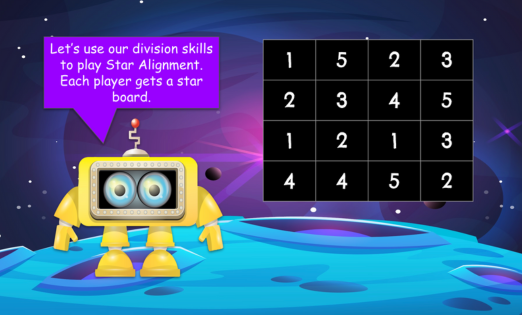
Students will apply their understanding of remainders to solve problems, developing their ability to work with division and recognize how remainders fit into larger calculations. Students will play a game called Star Alignment to continue to solve division with remainders.

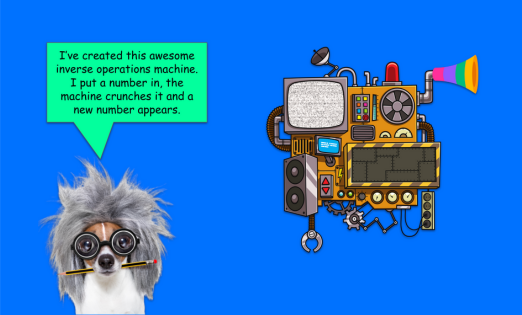
Students will explore the strong connection between multiplication and division, discovering how this relationship can be used to efficiently solve problems in both operations. Students will use inverse operations to solve ‘function machine’ problems.

Students will continue to explore the connection between division and multiplication through inverse operations and apply this knowledge when creating and solving number riddles.

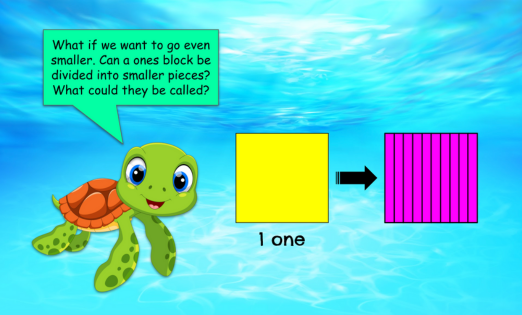
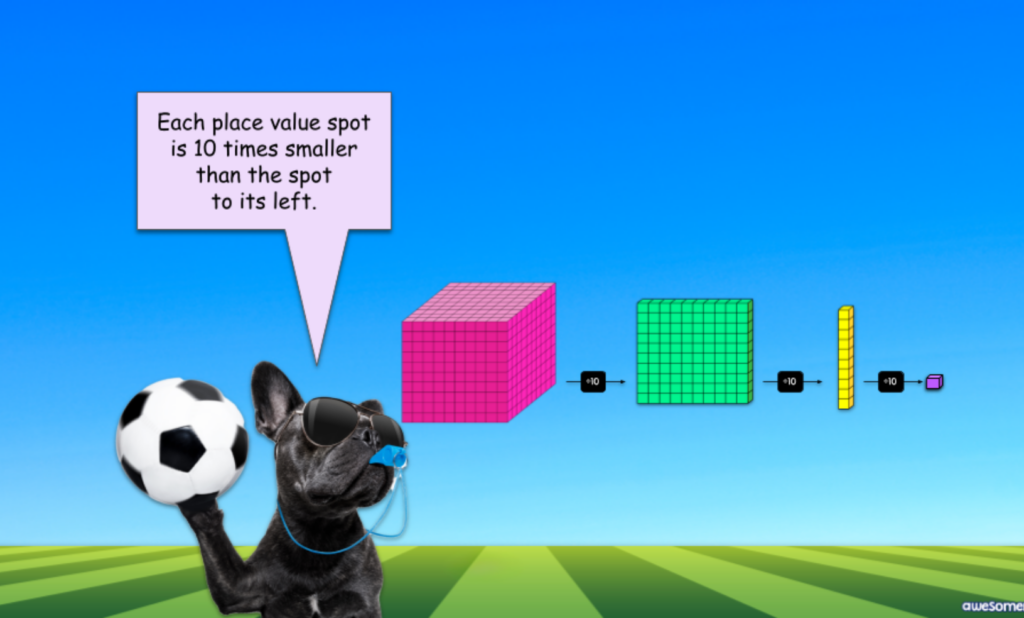
Students will apply their understanding of place value to divide numbers by 10 and 100, gaining a deeper insight into how place value shifts with each division. They will also make connections between dividing and multiplying by 10 and 100, strengthening their mathematical fluency. They will explore this concept further by playing a game called Smack of Jellyfish.

Students will continue to apply their skills in dividing by 10 and 100, while also comparing the resulting quotients. This will help them deepen their understanding of how division affects numbers. They will apply their knowledge whilst comparing amounts on animal ‘skillz cards’.

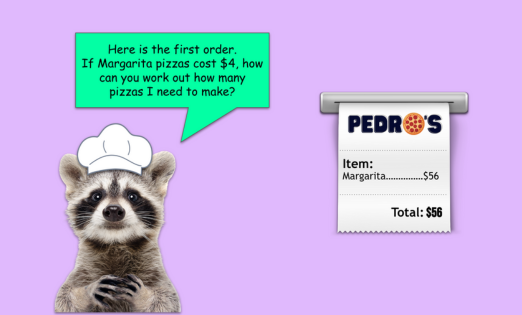
Students will use place value dot division to divide larger numbers, which provides a conceptual understanding for other written strategies explored in the future. Students will apply their understanding in a pizza receipts activity.

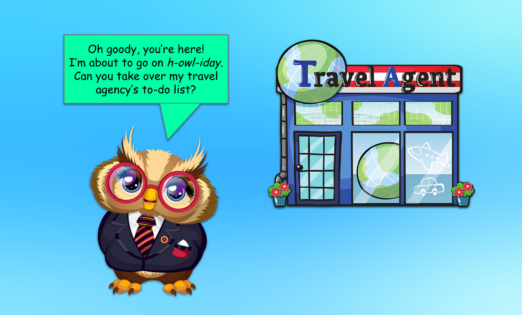
Students will use jump strategy to divide. Jump strategy involves using a number line to repeatedly add groups of the divisor to find out how many groups ‘fit inside’ the dividend. Students use this amount to find the quotient. They will practice this strategy by helping a travel agency to organize their tours.

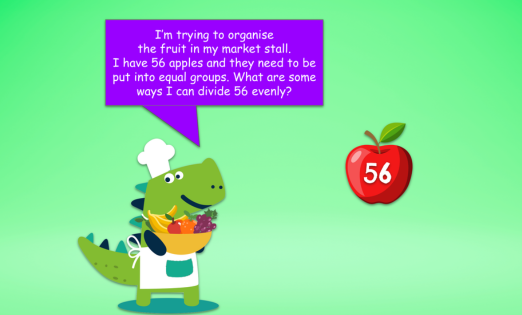
Students will use patterns and critical thinking skills to identify and explore divisibility rules. They will engage in a market stall activity to investigate rules of divisibility.

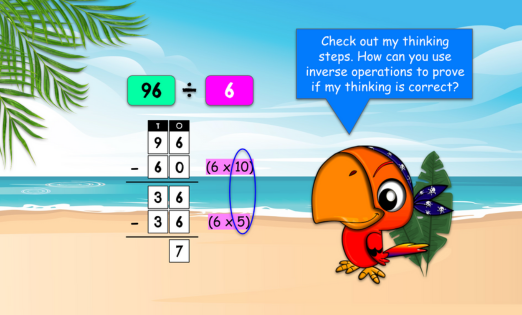
Students will use chunking strategy to solve division. Chunking strategy involves repeatedly subtracting the divisor from the dividend to find the quotient. Students will practice this strategy whilst investigating how much treasure different pirate crews will get from a shipwreck.

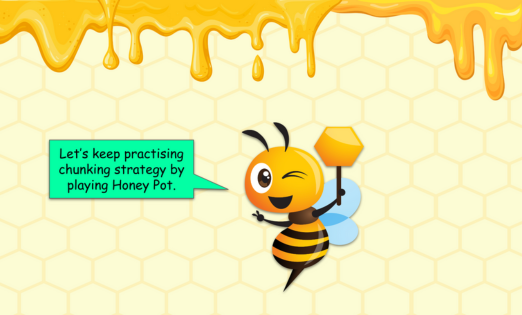
Students will apply their knowledge of chunking strategy with a fun scenario based division game called Honey Pot.

Students will use their multiplication and division knowledge to complete problem-solving puzzles.

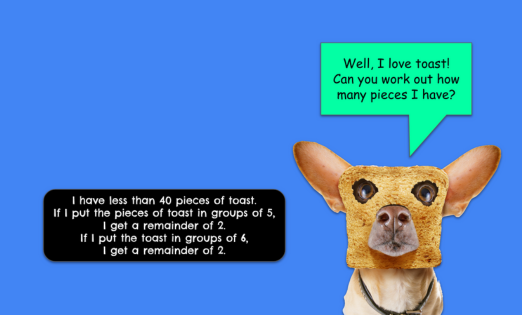
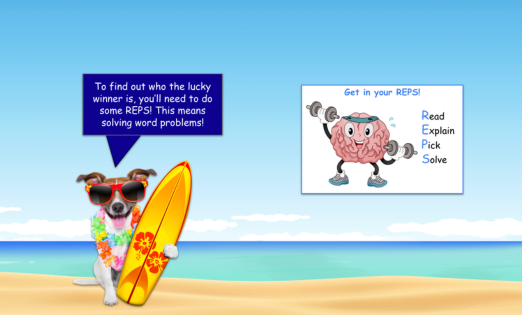
Students will use their knowledge of division and multiplication to solve word problems.

This is a summative assessment that covers the key objectives from this division unit.