Step 3: Start lesson 1 and have a look around

Students will practise skip counting to identify and understand which specific numbers are multiples of a given value. This approach will help them recognise patterns in the number system and build a stronger foundation in multiplication. Students will practice skip counting to identify multiples with a game called Escape the Multiples Maze.

Students will investigate multiples and look for connections and patterns to make ‘I noticed’ statements.

Students will explore factors by investigating and analysing various number cards. This inquiry will deepen their understanding of factors and their role in multiplication and division.

Students will identify factors and make connections between numbers that share similar factor amounts, enhancing their understanding of how factors relate to one another and to the structure of numbers. Students will use their findings to create factor bug buddies.

Students will explore the relationship between multiplying by 2 and 4, discovering that doubling a number twice provides an effective strategy for multiplying by 4. This approach reinforces their understanding of multiplication patterns and strengthens their fluency with related times tables. Students can practice multiplying by 2 and 4 by playing a hands-on target practice game.

Students will explore the connection between multiplying by 3 and 6, recognising that multiplying by 6 is equivalent to doubling a product of 3. They will use this understanding to develop efficient strategies for solving problems involving the 6 times table, deepening their understanding of multiplication patterns. Students will apply this knowledge to a potion making activity.

This lesson will explore the connection between multiplying by 4 and 8. Students will use this relationship to develop an effective strategy for multiplying by 8. Students will practice multiplying by 4 and 8 by playing a game called Budge.

Students will apply their understanding of multiplying by 10 and the concept of equal groups to develop efficient strategies for multiplying by 9, building confidence and fluency in their multiplication skills. They will practice multiplying by 9 by playing a game called Carrot Crunch.

Students will revisit the strategies learned throughout this unit and apply them to develop an effective approach for multiplying by 7, reinforcing their understanding and problem-solving skills. They will practice multiplying by 7 by playing a game called Super 7s, which involves luck and strategy.

Students will revisit the connection between each place value column and use this information to begin to multiply by ten. They will do this by exploring what happens to digits when they become 10x larger. In this lesson, students will play Cross the River, which is a dice/card game.

Students will recap on the connection between each place value column and use this knowledge to dive into the concept of multiplying by 10, 100 and 1,000. They will use this information to find out who won the monster eating contest.

Students will use flexible thinking to manipulate and multiply multiples of 10, developing strategies that enhance their understanding of number patterns and multiplication. They will practice their strategies whilst playing a game called Going for Gold.

This lesson uses picture dots and place value columns to show the conceptual process of multiplying large amounts with regrouping. This will provide the foundation for partial product and short multiplication. Students will practice using picture dot multiplication whilst playing a game called Multiplication Showdown.

Students will use grid method to multiply. This involves partitioning the numbers into like units and multiplying each unit, before adding the amounts at the end to find the total. Students will practice this strategy whilst calculating how much each customer has spent at a music store.

Students will apply their knowledge of grid strategy from the previous lesson and use it to engage in an activity that involves matching odd socks.

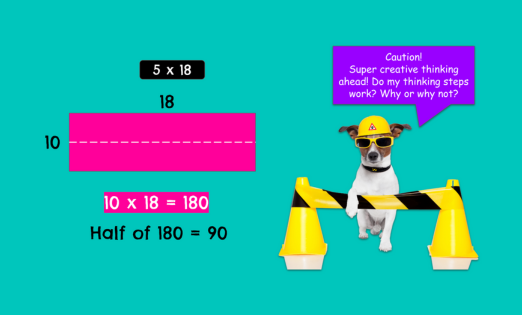
This lesson introduces students to compensation multiplication. They will round one of the numbers and then either add or subtract groups at the end to compensate and find the actual total. Students will use the strategy to calculate the cost of each lion’s lunch.

Students will engage with a range of creative and flexible strategies, developing their own approaches to multiplying effectively. They will explore multiple methods for solving number sentences in groups, enhancing both their problem-solving abilities and communication skills through collaborative discussions and number talks.

Students will explore using partial product to multiply larger amounts. Partial product strategy involves finding the product of two numbers, which are broken into parts. Each part is multiplied separately, before being added together to find the final total. They will practice this strategy by playing a game called Product Prediction.

Students will create 3-digit x 1-digit number sentences that match certain challenges and use partial product strategy to solve them.

Students will use their multiplication knowledge and skills to problem-solve and solve a mystery that involves finding a cupcake criminal.

This is a summative assessment that covers the key objectives from this multiplication unit.