
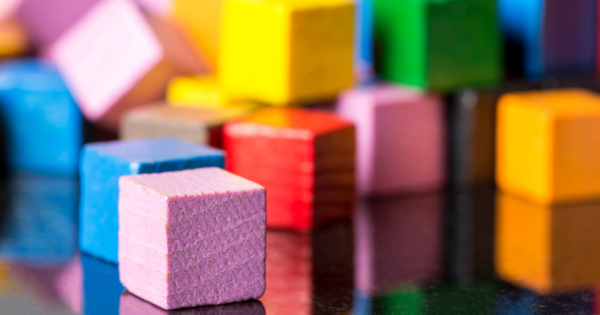
If you homeschool, you may have wondered whether your child is getting a little too old for blocks, counters and other maths manipulatives.
Manipulatives are physical objects that children can handle and move to represent mathematical ideas. Manipulatives can be things like blocks, counters, fraction pieces, tiles, dice or even everyday objects you have around the house.
We often think of them as something younger children use to learn the basics. But are they really something children are supposed to outgrow?
A few years ago, I was teaching halves in a 2nd grade class.
The children had a heap of different-coloured blocks in front of them and one simple challenge:
Can you arrange your blocks to show halves?
A visiting principal was observing the lesson. He watched for a little while before asking,
“Don’t you think these students are too old to be using manipulatives?”
He wasn’t being unkind. He was working from a familiar view that concrete materials are there to help children who need extra support, and that, as children become more mathematically capable, they no longer “need” manipulatives.
But that wasn’t what was happening in this classroom.
The students had their blocks and were ready to explore.
At first, they created fairly simple halves.
Then I introduced another question:
How many different ways can you show halves?
Suddenly, the maths became much more interesting.
The children began rearranging their blocks, trying different colours, numbers and arrangements. They compared their constructions, questioned one another and checked whether someone else’s model really showed halves.
Some began making a whole and partitioning it in different ways. Some started exploring quarters.
They were no longer simply looking for a right-or-wrong answer.
They were investigating a mathematical idea.
They were asking,
What makes something a half?
Does this still show halves?
Can I make halves in a completely different way?
The children had taken a simple mathematical idea and pushed it further than I had explicitly asked them to.
As the lesson continued, I showed the principal what they were building. He began walking around the room, asking questions and listening to their explanations.
And gradually, I could see the assumption behind his original question beginning to shift.
The students weren’t getting an easier lesson, or using blocks because they were struggling.
By providing the blocks, every child had something concrete to think with. They could build, manipulate, compare, question and explain.
The materials hadn’t lowered the level of mathematics.
If anything, they had pushed the mathematics further than the worksheet alone could have.
The children weren’t simply colouring in a predetermined answer.
They were constructing and testing their own mathematical ideas.
So, when should you stop using manipulatives?
Rather than asking when your child might outgrow manipulatives, the more important question that should be asked is:
“What could my child understand by using them?”
As children get older, the mathematics can become more sophisticated. They might use blocks to explore fractions, tiles to investigate area, objects to model multiplication, or concrete materials to look for patterns and test mathematical ideas.
The important thing isn’t the manipulative itself.
It’s what your child is doing with it.
Are they simply following instructions?
Or are they using it to notice, explore, compare, explain and reason?
One of the wonderful things about homeschooling is that you don’t need to turn every maths lesson into a worksheet. You can put some blocks in front of your child and ask:
How could we use these blocks to show halves?
Then:
Can you make it another way?
How many different ways can you find?
A simple question can become a much deeper mathematical investigation.
And that’s the myth I want us to challenge: that manipulatives are only for little children, or only for children who are struggling.
Children don’t necessarily outgrow manipulatives. Their use of them grows with their mathematics.
So instead of asking whether your child is too old to use a manipulative, ask:
What mathematical thinking could this manipulative make possible?