Lesson 15: Let’s use grid method to multiply 2-digit numbers

Students will use grid method to multiply. This involves partitioning the numbers into like units and multiplying each unit, before adding the amounts at the end to find the total. Students will practice this strategy whilst calculating how much each customer has spent at a music store.
Lesson 14: Let’s use place value dots to multiply 2-digit numbers

This lesson uses picture dots and place value columns to show the conceptual process of multiplying large amounts with regrouping. This will provide the foundation for partial product and short multiplication. Students will practice using picture dot multiplication to find out how much money the animals spent on their snow holidays.
Lesson 13: Let’s multiply multiples of 10

Students will use flexible thinking to manipulate and multiply multiples of 10, developing strategies that enhance their understanding of number patterns and multiplication. They will practice their strategies whilst playing a game called Going for Gold.
Lesson 12: Let’s multiply numbers by 10, 100 and 1,000

Students will recap on the connection between each place value column and use this knowledge to dive into the concept of multiplying by 10, 100 and 1,000. They will use this information to find out who won the monster eating contest.
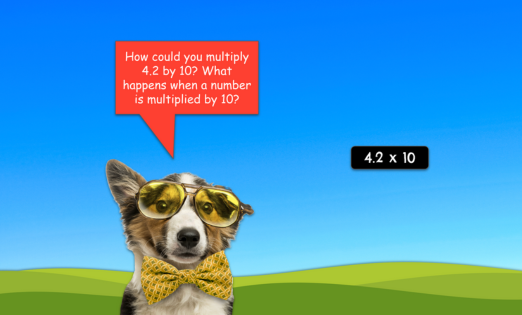
Lesson 11: Let’s multiply larger numbers by 10

Students will revisit the connection between each place value column and use this information to begin to multiply by ten. They will do this by exploring what happens to digits when they become 10x larger. In this lesson, students will play Cross the River, which is a dice/card game.
Lesson 10: Let’s multiply by 7

Students will revisit the strategies learned throughout this unit and apply them to develop an effective approach for multiplying by 7, reinforcing their understanding and problem-solving skills. They will practice multiplying by 7 by playing a game where they find a pathway to the Fire Egg.
Lesson 9: Let’s multiply by 9

Students will apply their understanding of multiplying by 10 and the concept of equal groups to develop efficient strategies for multiplying by 9. Students will practice multiplying by 9 by playing a game called Carrot Connections.
Lesson 8: Let’s multiply by 4 and 8

This lesson will explore the connection between multiplying by 4 and 8. Students will use this relationship to develop an effective strategy for multiplying by 8. Students will practice multiplying by 4 and 8 by playing a game called Back Yard Bingo.
Lesson 7: Let’s multiply by 3 and 6

Students will explore using times table connections to multiply numbers by 3 and by 6. Students will apply their understanding to a potion making activity.
Lesson 6: Let’s multiply by 2 and 4

Students will explore the relationship between multiplying by 2 and 4, discovering that doubling a number twice provides an effective strategy for multiplying by 4. This approach reinforces their understanding of multiplication patterns and strengthens their fluency with related times tables. Students can practice multiplying by 2 and 4 by playing a hands-on target practice […]